How It All Began
Every child has the right to education, although their experiences may vary from one individual to another. Many face difficulties with abstract ideas and are marginalised by a system designed around a single teaching method. To close the historic educational gap rooted in colonial history, a small pilot programme was launched in 2011 at the Hunarshala campus. It supported ten students by offering a space for hands-on learning — enabling them to find joy in building with their own hands and regain pride in their skills.
Karigar Shala has always adhered to a simple yet powerful principle: learning through hands-on experience. By 2013, students had already built their own hostel, and carpentry trainees had constructed the roof for a community prayer space near Shirdi. These early projects demonstrated how education flourishes when rooted in tradition, mentorship, and practical knowledge.
Over time, students from across Gujarat and neighbouring states, such as Maharashtra and Madhya Pradesh, began to arrive. Karigar Shala partnered with universities and institutions to provide students with practical project experiences. In 2021, during the COVID-19 pandemic, Karigar Shala was also affected by the crisis. After navigating pandemic-related difficulties, it became an independent organisation separate from its parent, Hunarshala, and took confident steps toward creating a school of makers.
Karigar Shala has welcomed a new group of board members, who are practising professionals from various fields, including architecture, education, design, and art. Their insights, combined with the institution's decade-long history as an educational experiment, have led to a revamped curriculum that integrates art, design, and entrepreneurship through interactive workshops. With ambitions to expand the campus and redesign its educational programme, Karigar Shala continues to evolve—backed by alumni, artisans, educators, and institutions across the country.
More than just a school, it is a movement dedicated to reviving pride in craftsmanship, recognising indigenous knowledge, and developing self-reliance pathways for future generations of young artisans.
Journey Through the Years
-
Karigar Shala was thoughtfully created to offer a valuable vocational training programme specifically for school dropouts. Its well-designed curriculum integrates two successful teaching methods: a hands-on approach where young learners collaborate directly with master artisans to develop their skills, and classroom lessons on various subjects. This blend enhances their practical skills and also promotes their personal development.
-
Karigar Shala welcomed ten students, including Pooja, a girl courageously learning carpentry—a field rarely for girls. Her enthusiasm inspired everyone. While learning carpentry, understanding basic arithmetic is key. During a fractions lesson, a student cheerfully said, "Learning fractions is easy and reminds me of how I struggled in school and was scolded... I went to school for the last time that day." This shows vocational training has limits; hands-on making helps students reconnect and build confidence. From then, Karigar Shala’s vision expanded: making isn’t just about creating but about a learning journey. Fostering a nurturing, making focused environment helps students develop problem-solving skills and become thoughtful, capable individuals. Today, this vision continues through a curriculum valuing exploration and creation.
-
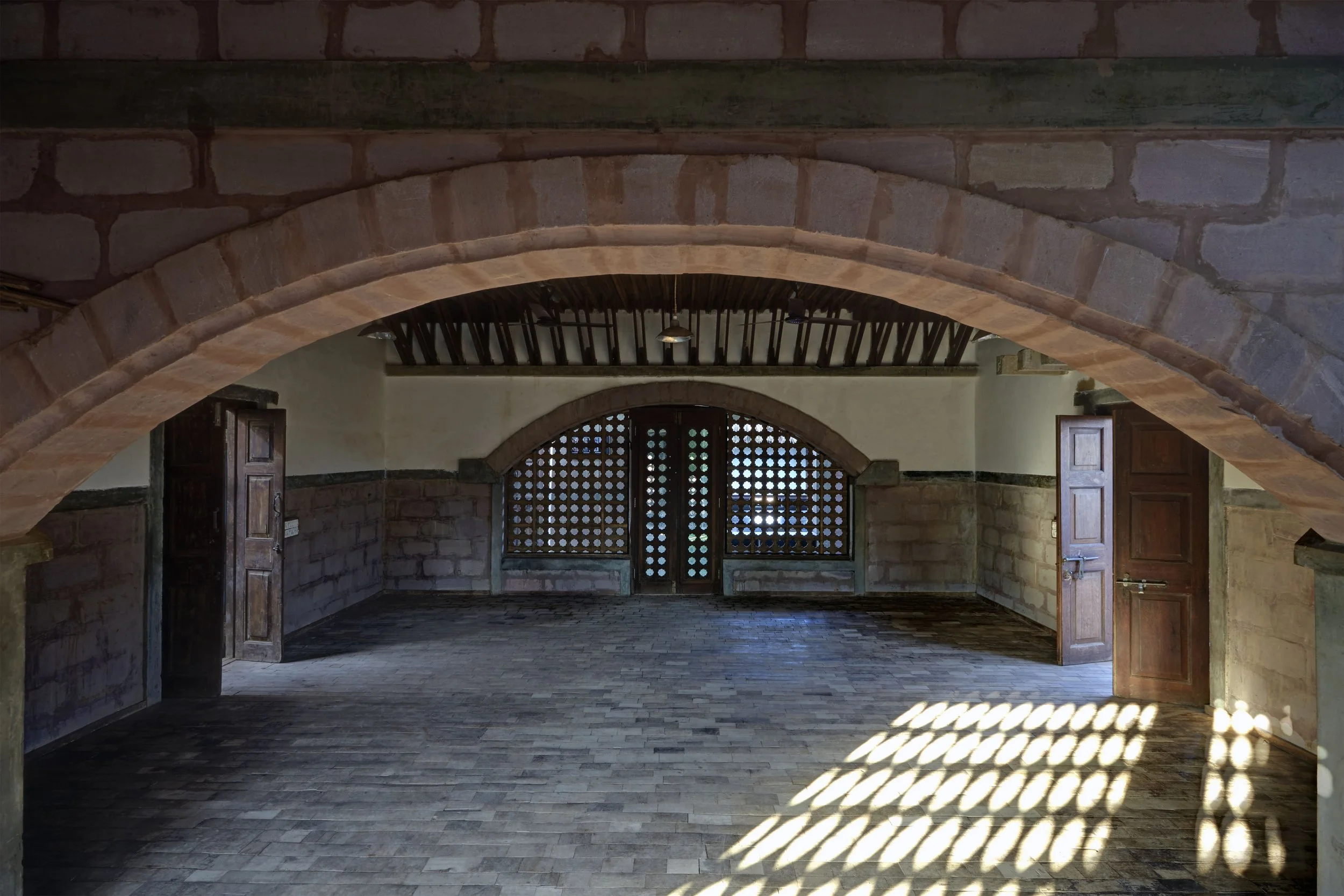
By that time, the student body had grown to over 30 students. Alongside Karigar Shala, Hunnarshala became quite crowded, with many students living in rented homes outside the learning space. To address this, new land was acquired to develop a dedicated campus for Karigar Shala. The idea of students building their own school was received very positively and generated great enthusiasm, with students responding eagerly. Guided by master artisans, they confidently accepted the challenge and successfully constructed their own school. Notably, around 80% of the campus was built by the students themselves. Our initial visit to Auroville highlighted how travel can significantly enhance learning, especially in aesthetics and design thinking. Furthermore, many participants saw this as an opportunity to resume or further their formal education.
-
Since its inception, Karigar Shala has emphasised questioning as a key learning aspect, fostering a warm, supportive environment. This approach has encouraged students to explore and improve traditional building techniques, leading to progress in roofing and well-reasoned designs. Inspired by alumni stories, we saw many feel exploited in today's market. We established incubation companies—Ozari for carpentry and Kamerai for masonry—to offer fair opportunities and support for graduates. This has enabled students to participate in projects like Jetavan in Maharashtra, the Art Village in Karjat, and Aavadat in Ahmedabad, boosting their personal and professional growth.
-
Several projects were initiated through incubation companies, with two becoming iconic. Students earned fair wages plus an extra ₹50,000 each, boosting confidence and community impact. The incubation platform fostered learning about entrepreneurship, showcasing the transformative power of skills and ethics.
Sarvodaya Parivar, working with tribal communities, partnered with Karigar Shala. As a result, 14 students from Pindwal, Dharampur in South Gujarat, participated in the programme, expanding the school's reach.
-
As the learning environment became more dynamic, students absorbed knowledge faster and completed nearly the entire course in 8-9 months, making it rewarding. The idea of live projects was introduced, adding depth and excitement. Under our dedicated faculty, students participated enthusiastically in a campus
The Malvia Education Trust project in Kukeri involved completing all assigned stages, helping develop skills like cost management, effective techniques, time management, and discipline. This hands-on experience boosted confidence and prepared them for future opportunities at Ozari and Kamerai.
-
New live projects inspire students and encourage participation in construction tasks. They are now vital to the curriculum, blending practical experience with real-world problem-solving. For example, PhD students from the University of Cambridge and Karigar Shala tested structural strength for a research paper, demonstrating how expertise, creativity, and dedication can lead to impactful results.
-
At Karigar Shala, we focus on developing a curriculum that genuinely supports growth and talents. In Learning Mode, students comfortably explore new knowledge through observation and hands-on activities, building a solid foundation. Production Mode then helps them confidently turn what they've learned into real, meaningful work, fostering a sense of achievement and highlighting areas for further development. Finally, in efficiency mode, students learn to work quickly, accurately, and with discipline, preparing them to excel as skilled artisans and succeed professionally.
-
Since its inception, Karigar Shala has collaborated with numerous design institutes, bringing together students from diverse backgrounds to explore creative learning and design methods. This year, the Centre for Learning in Bangalore, an alternative school dedicated to innovative education, visited Karigar Shala with 25 enthusiastic students. They enjoyed a wonderful week exploring the process from abstract ideas to hands-on, experimental projects. By uniting students from various fields, they created new opportunities that inspired creativity and promoted innovative learning approaches.
-
During the pandemic’s peaceful moments at Karigar Shala, we seized a valuable opportunity to pause and reflect on a decade of innovative teaching and learning. Over the years, through various highs and lows, we've seen how art, craft, design, and entrepreneurship do more than make learning enjoyable — they genuinely empower students to succeed in their creative pursuits. These experiences motivated us to enhance our programme with greater care, which is why we expanded our original two-semester course into three, aiming to foster stronger links between these fields. We believe this approach is vital for nurturing well-rounded, future-ready learners. Many alumni faced unemployment during the pandemic, inspiring us to find more effective ways to support them through difficult times. We launched a series of engaging workshops for 30 students, focusing on essential skills such as presenting work, planning projects, and understanding necessary finance and banking concepts. Designed with safety as a top priority, these sessions provided a supportive environment for our alumni to acquire new skills, stay connected, and further develop their artistic abilities. We are fully dedicated to supporting their success at every stage!
-
This academic year offered exciting growth opportunities: How can we expand our educational programmes? How can we move beyond simply testing new teaching methods to make a lasting impact? How can we attract a larger audience? What small, deliberate steps can we take to create a welcoming and inspiring platform where new voices and individuals feel truly motivated to join us on this meaningful journey? Inspired by these questions, we established the Karigar Shala Trust, celebrating a joyful milestone supported by Hunnarshala and our new patrons. Although we have 11 years of experience, founding the Trust feels like beginning a new chapter—an exciting, promising start.
-
At Karigar Shala, we've crafted a carefully designed internship programme aimed at providing students with a meaningful and focused experience. Whether students choose to specialise in production or prefer a mix of design and production, we ensure they have opportunities to explore both areas. This approach helps students develop a comprehensive understanding of the industry, enriching their educational journey.
Throughout this process, students develop essential skills in production planning, design exploration, and practical creation. By the end of the course, each student is inspired to craft a masterpiece that showcases their journey, highlights their progress, and reflects significant growth in their artisanal skills.
-
As an independent organisation, Karigar Shala has successfully expanded its educational programmes despite limited resources. To support this notable growth, Bajaj Finserve, believing in our journey, sponsored the education program for three years through their CSR initiative. Their generosity has significantly helped us to continue and enhance our mission.
Design students have always valued their collaboration with Karigar Shala. Recently, our partnership has strengthened through a joint effort with the Indhubhai Parekh School of Architecture in Rajkot. This new development not only enhances our relationship but also provides exciting and motivating learning opportunities for everyone involved.
-
Navrachana University hosted a furniture design workshop on campus for its students, including those from Karigar Shala, as co-learners. This collaboration enabled our students to experience a formal design school environment, marking the emergence of a new model of exposure that bridges hands-on artisanal practice with academic design education.
Be a part of the journey.
-
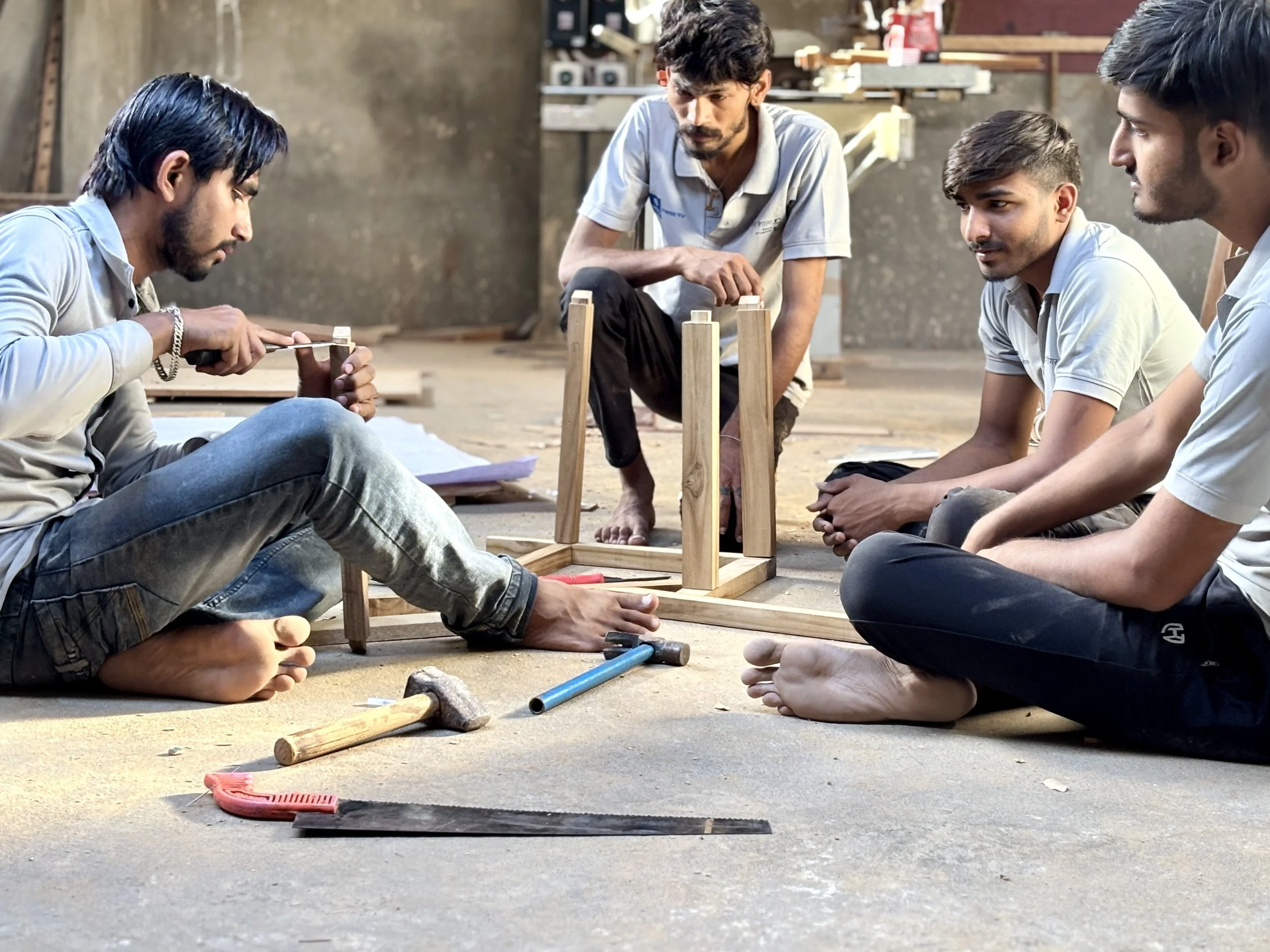
![Four young men working on assembling a wooden stool in a workshop, sitting on the floor surrounded by tools.]()
Teach
Karigar Shala invites passionate professionals from various fields related to construction, design, craft, arts, and management to share their expertise through teaching and workshops. If you wish to contribute socially or technically, we welcome you to join our community and inspire young artisans while promoting meaningful learning and growth.
-
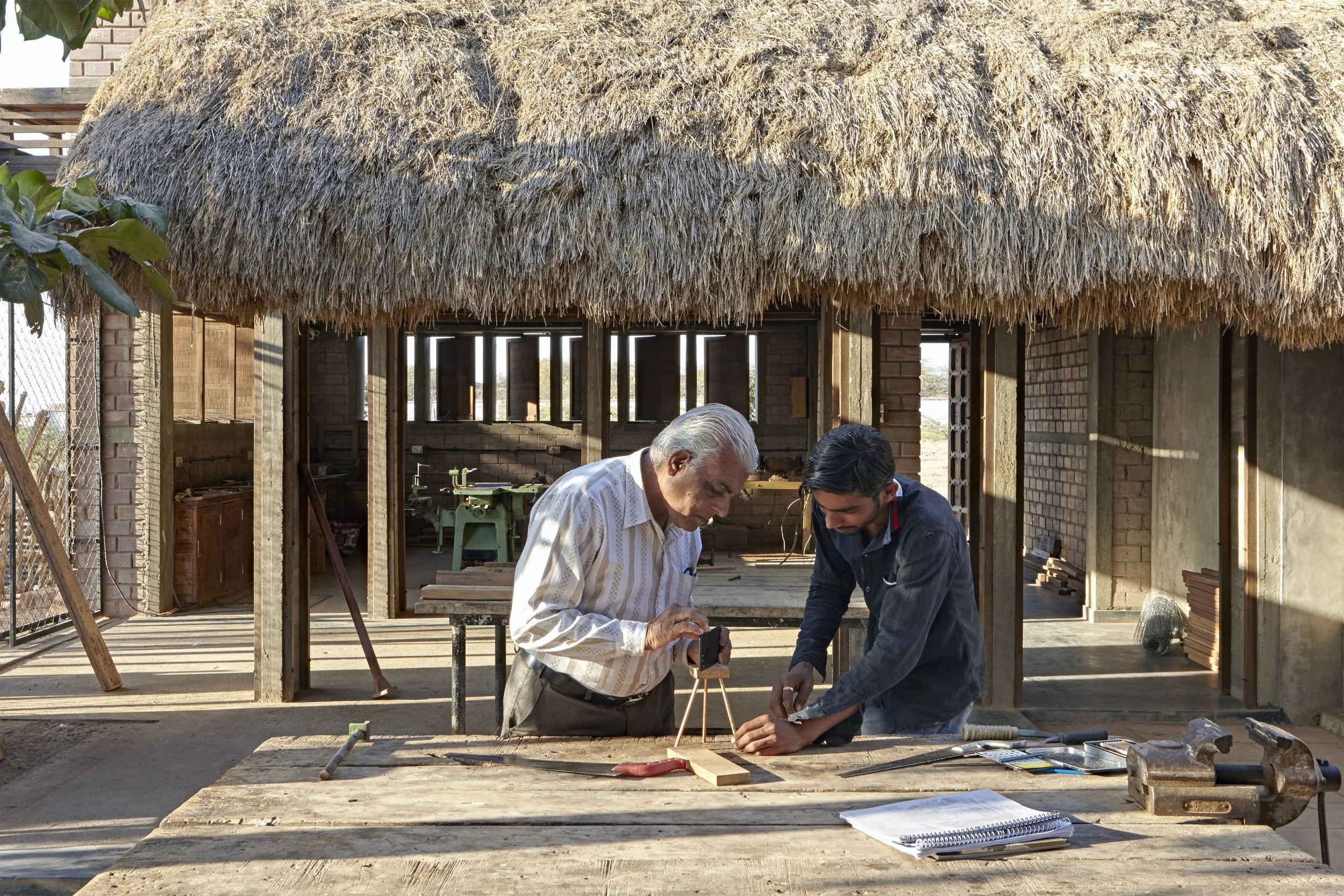
![Two men working together on a woodworking project outdoors under a thatched roof. One older man and one younger man are measuring a piece of wood on a workbench surrounded by tools and plans.]()
Collaborate
At Karigar Shala, we invite individuals and institutions to collaborate through skill-sharing, partnerships, and exchange programmes. Together, we can do more than teach—broaden horizons, connect visions, and develop artisan education that equips young artisans with the confidence and competence they need for the future. Through collaboration, our shared Journey will continue to enrich both traditional and modern practices.
-
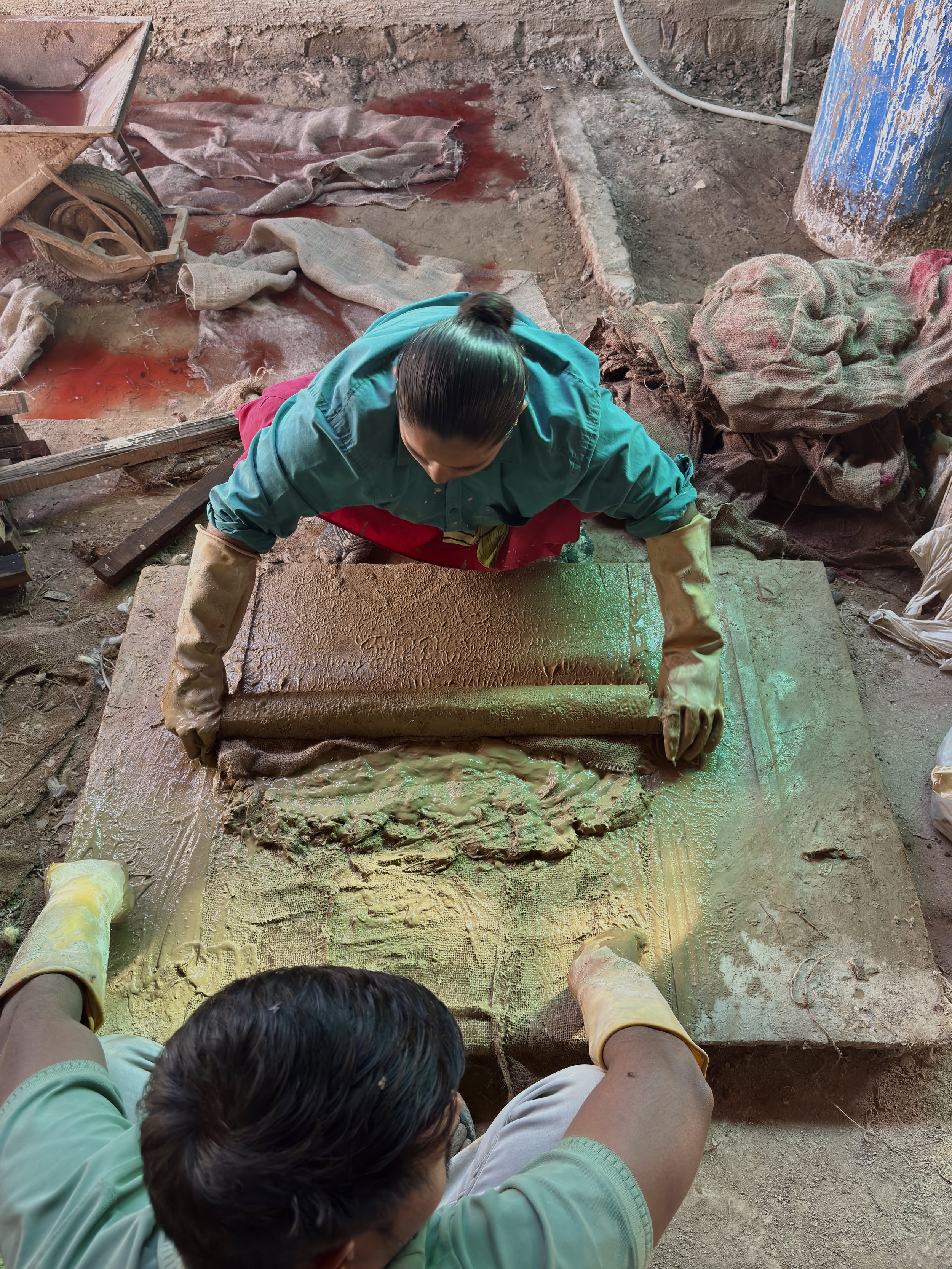
![Two people working with clay or mud, using a rolling pin, on a large slab outdoors, surrounded by construction tools and rags.]()
Volunteer
Karigar Shala encourages volunteers to dedicate their time and skills in meaningful ways. Whether volunteering for weeks or years, volunteers are free to choose how they wish to participate, fostering community exchange, creating lasting impact, and nurturing mutual growth as part of our family and the journeys of young artisans.
-
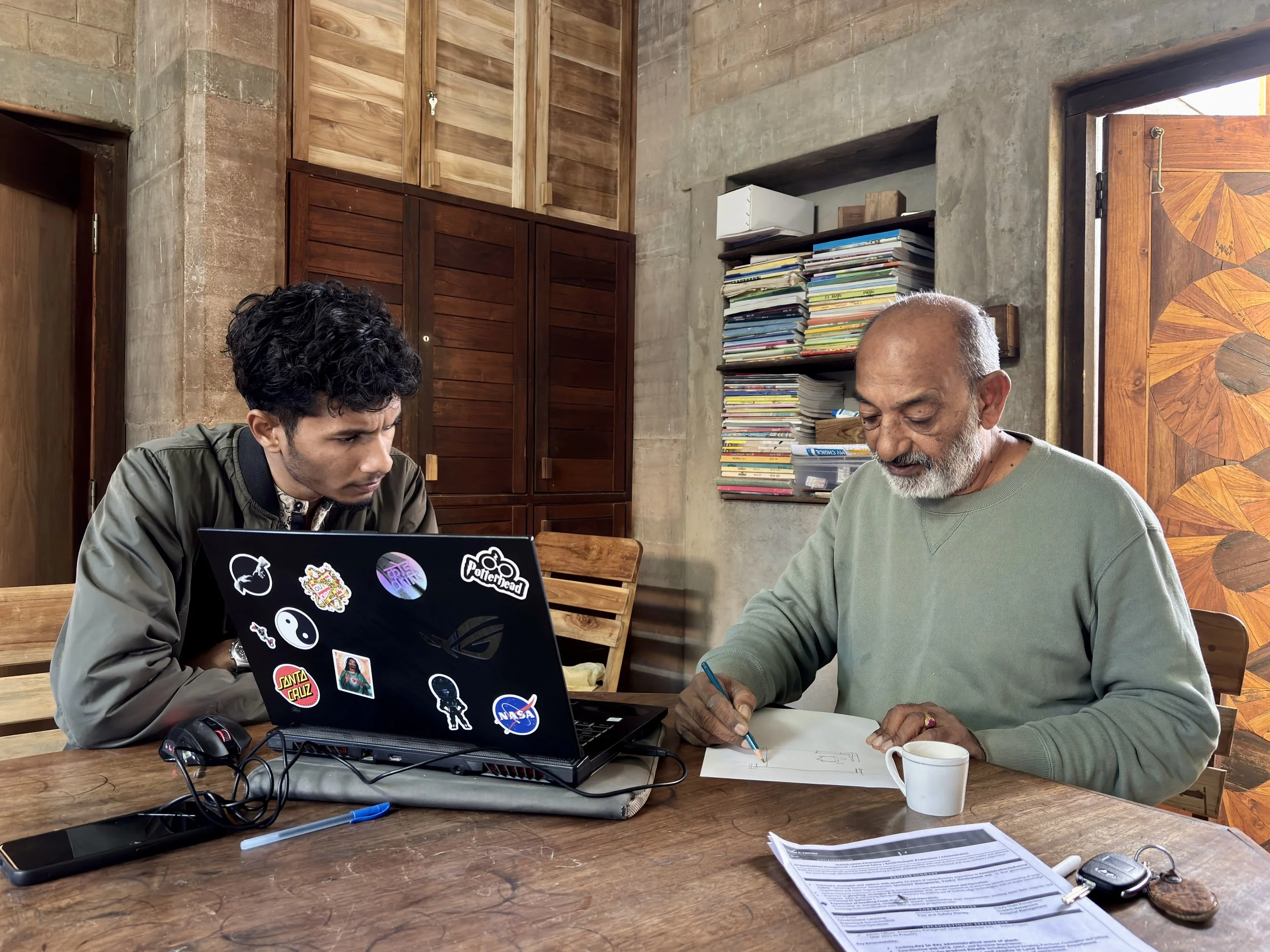
![Two men sitting at a wooden table, one young with black curly hair working on a laptop with stickers, the other older with gray hair and beard writing on paper with a cup of coffee nearby, in a room with wooden and concrete walls and a shelf full of stacked papers or books.]()
Intern
Karigar Shala invites interns to participate in its practical learning environment. Your existing knowledge will be enhanced through hands-on experience as you explore craft education, community development, and sustainable design, contributing to meaningful projects while enjoying a rewarding journey with young artisan learners.
-
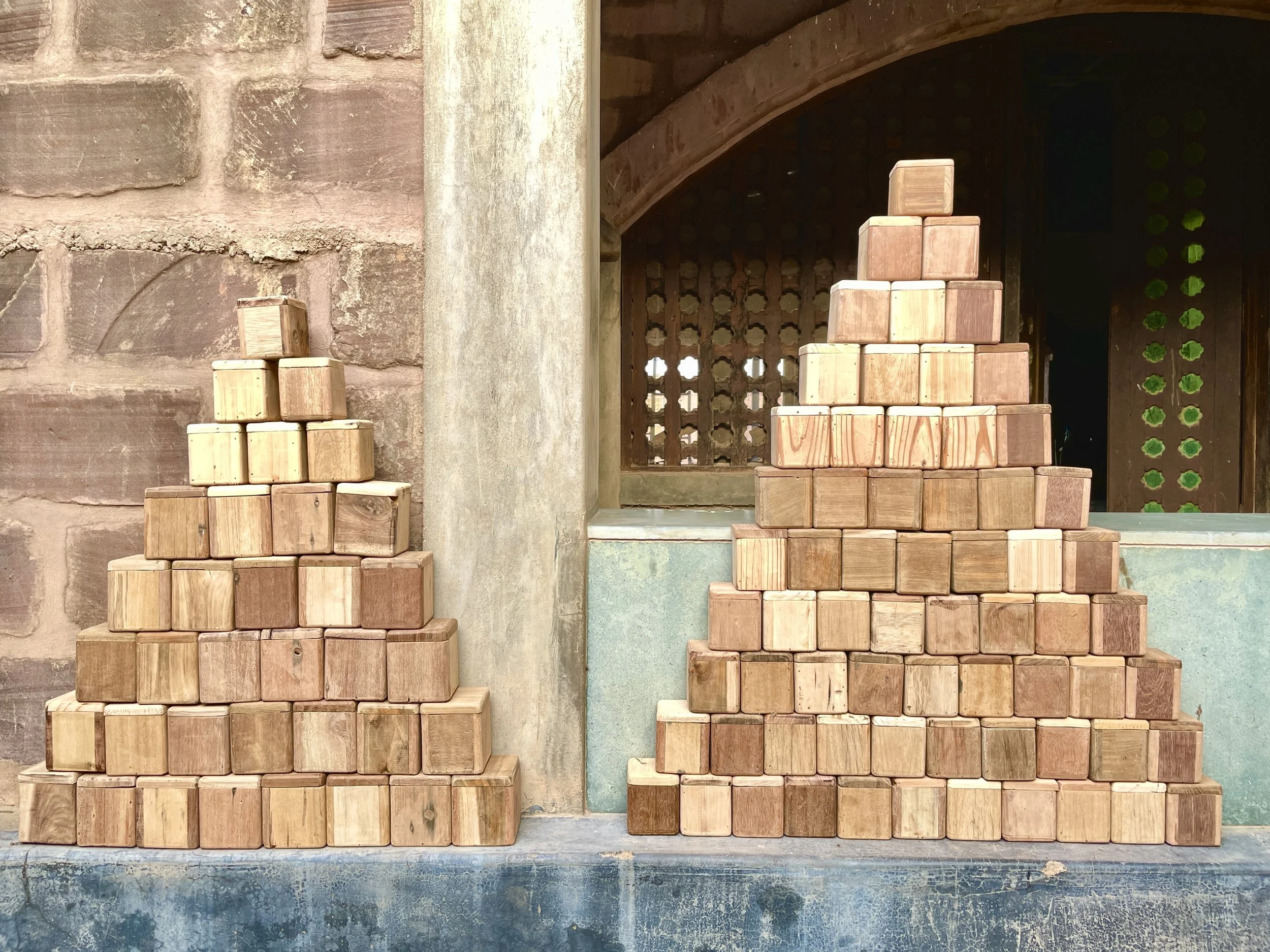
![Two pyramids of stacked wooden blocks on a concrete surface in front of a stone and brick wall.]()
Contribute
Karigar Shala welcomes individuals and organisations to contribute to craft education development through financial, material, or knowledge support. It also enables students from underprivileged backgrounds and nurtures a new generation of skilled, self-assured artisans, encouraging their overall growth.